



What are the fastest private jets in 2026? What is the maximum speed a business jet can reach?
In 2026, the answer is surprising: the world’s fastest business jet can reach Mach 0.95—a speed close to the speed of sound. The star of the show is the Bombardier Global 8000, which officially entered service after obtaining the necessary certifications in 2025 and January 2026. Bombardier calls it the fastest civilian aircraft since the Concorde.
Close behind is the Gulfstream G700, capable of Mach 0.935, while the Cessna Citation X+, now out of production but still found in private fleets, also reaches Mach 0.935.
But simply talking about faster jets is too simplistic. That’s because these aircraft must be able to combine extremely high speeds, intercontinental range, reasonable fuel consumption, and comfort. And that is precisely what makes their engineering achievement particularly interesting.
Bombardier Global 8000: The Fastest Private Jet of 2026
The Bombardier Global 8000 is currently the pinnacle of high-performance business aviation.
The maximum operating speed is Mach 0.95, while the range is approximately 8,000 nautical miles, equivalent to 14,816 km. The maximum altitude is 51,000 feet, approximately 15,545 meters.
These figures are impressive, especially since the Global 8000 is not a small jet built for speed. It is a large intercontinental business jet, capable of carrying up to 19 passengers and designed to connect very distant destinations without stopping.
The aircraft is powered by two GE Aerospace Passport engines, and its normal cruising speed is, of course, lower than its maximum speed. For long-range missions, the advantage lies in finding the best balance between speed, range, and fuel consumption.
What’s truly surprising, though, is what happened during the tests.
The Bombardier Global 8000 has indeed exceeded Mach 1
During development, Bombardier wanted to verify the aircraft’s performance at high speeds through a dedicated test program.
The prototype was accompanied by a NASA F/A-18, which served as a chase aircraft—that is, an aircraft tasked with following the experimental aircraft during the test.
Matthew Nicholls, Senior Advisor for Public Relations and Communications at Bombardier, said:
“Our test aircraft was accompanied by a NASA F/A-18 chase aircraft and broke the sound barrier.”
Source: Official Bombardier press release
During that test campaign, the aircraft actually exceeded Mach 1, reaching a speed of over Mach 1.015. The test was also conducted using SAF, Sustainable Aviation Fuel.
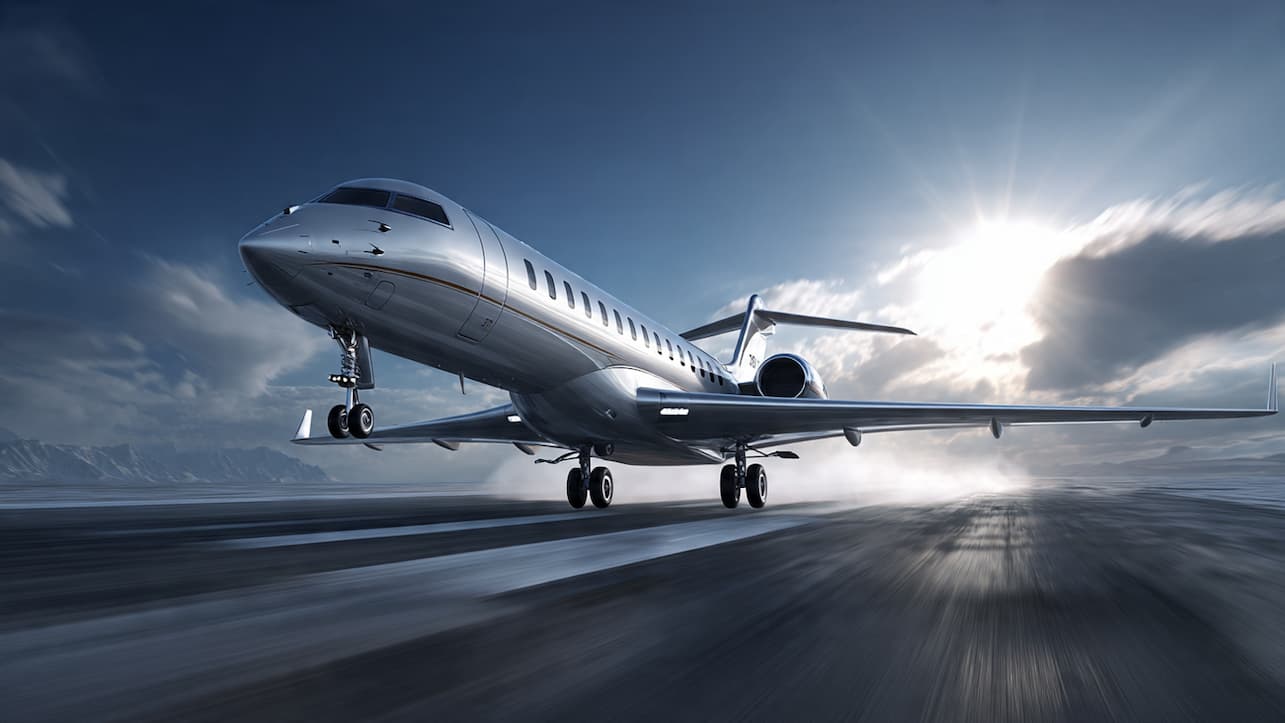
Of course, this does not mean that the Global 8000 is a certified supersonic aircraft: its maximum operational speed remains Mach 0.95. But the test demonstrates just how far the design was pushed during development.
It’s a detail that completely changes how we perceive this aircraft: we’re not just talking about a “fast” jet, but a machine designed to operate right on the aerodynamic boundary that separates subsonic flight from supersonic flight.
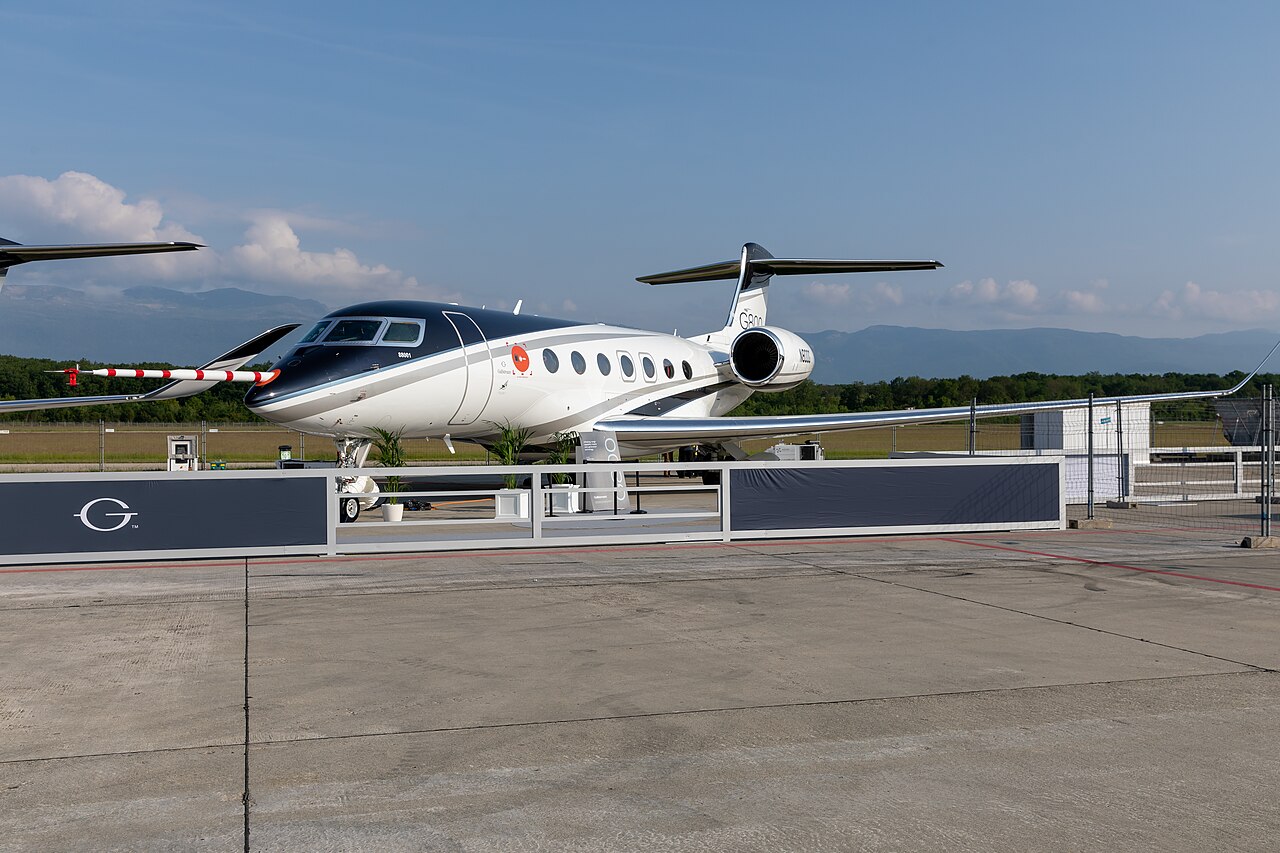
Gulfstream G700: Almost as Fast, but More Comfortable
The Gulfstream G700 represents a slightly different philosophy.
Its maximum operational speed is Mach 0.935, while its high-speed cruise speed reaches Mach 0.90. At a long-range cruise speed of Mach 0.85, the aircraft can achieve a maximum theoretical range of approximately 7,750 nautical miles, or 14,353 km. Its maximum altitude is 51,000 feet.
The G700 is powered by two Rolls-Royce Pearl 700 engines, each producing 81.20 kN of thrust. It can accommodate up to 19 passengers, and the cabin can be configured with up to five living areas.
Gulfstream’s philosophy is clear: it’s not just about building an aircraft capable of flying very fast, but about reducing travel time while maintaining an extremely comfortable cabin.
At Mach 0.90, for example, Gulfstream cites a theoretical range of approximately 6,650 nautical miles. The difference compared to the maximum range at Mach 0.85 demonstrates just how important the trade-off between speed and fuel consumption is.
The G700 is also an interesting example of just how difficult it is to make a large business jet efficient: its aerodynamics, wing, winglets, and Pearl 700 engines were developed to reduce fuel consumption and improve performance.
Gulfstream claims that its new generation of aircraft offers efficiency improvements of up to 33% compared to certain previous models, under specific comparison conditions.
Cessna Citation X+: The Veteran of Top Speed
The third main character has a completely different story.
The Cessna Citation X+ is no longer in production, but it remains one of the fastest business jets ever built. Its maximum speed is Mach 0.935, exactly the same as that of the G700. Its range is approximately 3,408 nautical miles, and its maximum altitude is 51,000 feet.
It is therefore important to clarify that, if we consider only the business jets currently in production, the Citation X+ is being replaced by the Gulfstream G800, which is also capable of Mach 0.935. The Citation, however, remains a key historical benchmark for understanding the evolution of speed in business aviation.
The Citation X was, in fact, designed with a very clear goal in mind: to be extremely fast.
And it was one of the pilots who flew him that described his behavior during the tests.
Gary Drummond, a senior production test pilot at Cessna, said after the first production flight:
“The Citation X was flawless today.”
Source: Official Textron/Cessna press release
Drummond also explained that during the flight, the plane had climbed to 49,000 feet and reached Mach 0.935, while the average cruising speed had been Mach 0.915 at 41,000 feet.
It is a particularly interesting account because behind that number—Mach 0.935—lies a test pilot and an entire test campaign designed to verify that the aircraft was truly controllable and stable at those speeds.
The Citation X+ and Business Jet Speed Records
The Citation X+ did more than just reach Mach 0.935 during testing.
In 2014, it set four speed records certified by the National Aeronautic Association on routes across the United States. The aircraft was configured to simulate a normal mission with a crew, four passengers, and luggage.
Cessna pilot Michael Voigt, who was at the controls during the record-breaking flights, said:
“It’s great to set records with the speeds we’ve seen from the Citation X+ starting with our earliest test flights.”
Source: Official Textron Aviation press release
This statement captures the project’s philosophy well: speed was not merely a byproduct of good aerodynamic design. It was one of the aircraft’s central objectives.
What does it mean to certify a jet at Mach 0.935?
An aircraft is not certified simply because it can reach a certain speed.
When the Citation X underwent the FAA’s high-speed tests, engineers also had to evaluate its handling, stability, control, and maneuverability.
Michael Thacker, then Senior Vice President of Engineering at Cessna, commented:
“The high-speed testing of the new Citation X was a success.”
He added that all of the aircraft’s responses had remained within the performance envelope specified by the engineers.
This is a fundamental point.
Approaching Mach 1 means entering a regime in which air compressibility and shock wave formation profoundly alter the aircraft’s aerodynamic behavior.
That is why the real achievement is not simply “pushing” a business jet to its limits.
It lies in flying the aircraft at the maximum controllable, predictable, and certifiable speed.
At what altitude do the fastest private jets fly?
Modern high-performance business jets can reach altitudes that we don’t normally associate with private aviation.
The Global 8000 and Gulfstream G700 reach 51,000 feet, an altitude of over 15.5 km. The Citation X was also one of the few business jets authorized to operate at this altitude.
Flying this high offers several advantages.
The air is less dense, and aerodynamic drag decreases, allowing the aircraft to maintain high speeds more efficiently. Furthermore, at these altitudes, the jet can avoid some of the air traffic concentrated at lower altitudes and, under certain conditions, fly above some atmospheric disturbances.
However, this does not mean that the jet automatically reaches 51,000 feet after takeoff. The altitude depends on weight, fuel, temperature, air traffic, and mission requirements.
How long do the fastest jets take to fly from London to Paris?
London-Paris is a perfect example of why a jet’s top speed does not correspond to the actual flight duration.
The distance as the crow flies is about 365 km.
At Mach 0.95, an airplane would theoretically cover the distance from London to Paris in less than twenty minutes. But in reality, it is impossible to maintain that maximum speed for the entire flight.
The jet must take off, climb, accelerate, reach cruising altitude, slow down, descend, and finally begin its approach.
On such a short flight, therefore, a significant portion of the time is spent during the climb and descent.
A realistic flight time for a fast business jet is in the range of 40 to 50 minutes, depending on the route assigned by air traffic control, wind conditions, air traffic, and the airports used.
And this is precisely where one of the great advantages of private aviation comes into play: often, the time saved isn’t just the time spent in the air.
A private jet can depart from an airport closer to the point of departure and arrive at an airport closer to the destination, avoiding much of the ground time typical of commercial aviation.
On the London-Paris route, therefore, the difference between Mach 0.85 and Mach 0.95 may be less significant than the ability to use more convenient airports.
- Compare now private jets available for charter
How much fuel will the fastest private jets consume in 2026?
Speed comes at a price: fuel.
The fuel consumption of a business jet is not a fixed value. It varies depending on weight, altitude, temperature, wind, the number of passengers, and, above all, speed.
For this reason, it is more accurate to speak of orders of magnitude rather than a single number that applies to every flight.
The Global 8000, for example, can consume several hundred gallons of fuel per hour under normal operating conditions, while a smaller jet like the Citation X+ has a lower hourly fuel consumption. But the comparison must also take into account the size of the aircraft, the number of passengers, and the range.
The G700, for example, can carry over 22,400 kg of fuel and reach a maximum takeoff weight of approximately 48,800 kg.
The most important fact, however, is something else: driving faster uses more fuel.
Flying at Mach 0.90 instead of Mach 0.85 can save time, but it reduces range and increases fuel consumption. That is why Gulfstream clearly distinguishes between long-range cruise at Mach 0.85 and high-speed cruise at Mach 0.90.
The fastest jet is therefore not necessarily the most efficient one.
The challenge for engineers is to find the point at which the reduction in travel time justifies the increased fuel consumption.
How Fast Are Military Fighter Jets: When Mach 0.95 Suddenly Seems Slow
To truly understand just how impressive the speeds reached by modern business jets are, we need to shift our perspective and compare them to fighter jets.
If we make this comparison , we have to realize that Mach 0.95 suddenly starts to seem much less extraordinary.
The Bombardier Global 8000 can reach Mach 0.95. A military fighter jet like the F-15E Strike Eagle, on the other hand, can exceed Mach 2.5—that is, about 3,000 km/h— and reach an altitude of 60,000 feet. These are official figures from the U.S. Air Force.

The difference is enormous: an F-15 can therefore reach a speed more than two and a half times that of the Global 8000.
But the comparison is particularly interesting for another reason.
Fighter jets are designed with combat performance in mind. Business jets, on the other hand, must build their performance around the travel experience.
An F-15 must be able to accelerate rapidly, reach the operational area, carry out its mission, and return, possibly with the support of in-flight refueling. The Global 8000, on the other hand, must transport passengers over thousands of kilometers, offering comfort, range, pressurization, and fuel efficiency suitable for an intercontinental mission.
That is the fundamental difference.
A military jet is built to fly very fast. A business jet has to fly very fast without using as much fuel as a fighter jet.
That’s why the Global 8000’s performance is interesting—not because it’s nearly as fast as a fighter jet; in absolute terms, it isn’t.
It’s interesting because it manages to approach the sound barrier with civilian turbofan engines, a spacious cabin, and a range of 8,000 nautical miles.
The true engineering marvel, therefore, is not Mach 0.95 in and of itself.
It’s Mach 0.95 without sacrificing intercontinental travel.
What are the technical challenges of a very fast jet?
Approaching the speed of sound isn’t simply a matter of power. It’s primarily a matter of physics.
When an aircraft enters the transonic region—the speed range between approximately Mach 0.75 and Mach 1—the air around the wing begins to behave radically differently. In some local areas, the speed of sound is already reached even when the aircraft as a whole is still flying below it. Shock waves form, aerodynamic drag increases sharply, and the pressure distribution around the aircraft changes in a way that is difficult to control.
Designing an aircraft certified for Mach 0.95 means solving all these problems in a predictable and repeatable manner, under all flight conditions. The wings must maintain stable aerodynamic characteristics even near the limits of the operating envelope. The fuselage must withstand structural stresses that simply do not exist at lower speeds. The flight controls must respond with the same precision at Mach 0.75 as they do at Mach 0.93.
And then there’s fuel consumption. To overcome transonic drag, you need more thrust, and more thrust means more fuel. It’s no coincidence that all manufacturers aiming for top speed must then grapple with range: the two goals are at odds with each other, and finding the right balance is one of the most complex engineering challenges in the entire industry.
The final obstacle is noise. The transition to supersonic speeds produces shock waves that travel down to the ground as a sudden roar—the sonic boom —and this is precisely what has held back the development of supersonic civil aviation for decades. The Global 8000 deliberately operates just below this threshold: Mach 0.95 is the absolute limit before the sonic boom problem becomes insurmountable without completely overhauling the design.
Can the fastest private jets land at any airport?
No—and that answer deserves more than just a simple “no.”
An intercontinental business jet like the Global 8000 or the G700 is not a small private aircraft. The G700, for example, has a maximum takeoff weight of approximately 48,807 kg and requires a takeoff distance of approximately 1,827 meters under standard conditions. These figures automatically rule out a significant portion of European airports—those with runways that are too short, pavement that cannot support the weight, or operational constraints related to altitude or obstacles on the approach path.
Added to this is the need for the appropriate fuel, customs procedures, and ground handling facilities equipped to handle aircraft of that category.
However, the advantage of business jets over large commercial wide-body aircraft remains enormous: they can use many secondary airports that are simply inaccessible to a Boeing 777. And that is precisely where private jets demonstrate their real advantage in terms of total travel time—not so much in cruising speed as in the ability to depart from and arrive closer to the actual destination, cutting out hours of ground transportation.
Flight speed is only part of the journey. Often, it isn’t even the most important part.
2026 and the New Generation of Business Jets
2026 is a particularly significant year for business aviation.
The Global 8000 is now certified and operational, with a maximum speed of Mach 0.95 and a claimed range of 8,000 nautical miles. Bombardier markets it as the world’s fastest business jet.
Gulfstream, for its part, continues to offer the G700 and G800, both of which are capable of reaching Mach 0.935.
The G800 is particularly interesting because it combines a speed of Mach 0.90 with a theoretical range of approximately 7,000 nautical miles at that speed and over 8,200 nautical miles at Mach 0.85.
This highlights an important trend: competition is no longer just about top speed.
The challenge lies in maintaining high speeds for thousands of kilometers without sacrificing too much range.
The Future of Private Aviation: When Will Supersonic Jets Arrive?
The next big breakthrough, however, might come from a completely different category.
One of the best-known projects is Boom Supersonic Overture, a supersonic passenger aircraft designed to reach speeds far exceeding those of modern business jets.

Its XB-1 prototype has already demonstrated the ability to exceed Mach 1 during tests and achieve supersonic flight.
However, the challenge will be much more complex than the one faced by the Global and Gulfstream aircraft.
An aircraft capable of Mach 1.7 faces greater aerodynamic drag, higher temperatures, higher fuel consumption, and, above all, the problem of the sonic boom.
That is why the return of supersonic flight will not depend simply on the technical ability to build a faster aircraft.
It will depend on whether it can be built to be sufficiently efficient, quiet, and economically viable.
Faster speeds, lower fuel consumption: the real challenge for the private jets of the future
The next generation of business aviation will have to strike an increasingly difficult balance among four elements:
speed, range, fuel economy, and comfort.
The Global 8000 demonstrates that it is now possible to reach Mach 0.95 while maintaining intercontinental range.
The next step will be to further improve transonic aerodynamics, composite materials, engines, thermal management, and flight control systems.
The SAF will also play an important role in reducing emissions, as demonstrated by the Global 8000 program itself during supersonic tests.
But the real revolution will come when it becomes possible to drastically increase speed without causing fuel consumption to rise proportionally.
This is the issue that will determine the outcome of the coming decades.
Because building an airplane capable of reaching Mach 1.5 or Mach 2 is a huge engineering challenge, but it isn’t necessarily the most difficult problem.
The real goal will be to build an aircraft capable of doing this while carrying passengers, traveling thousands of kilometers, complying with noise restrictions, and maintaining sustainable operating costs.
In 2026, the top performer in subsonic business aviation is the Bombardier Global 8000, with a speed of Mach 0.95.
But the fact that, during testing, a business jet managed to break the sound barrier—accompanied by a NASA F/A-18—perhaps speaks more clearly than any statistic about the direction in which aviation is heading.
For now, supersonic flight remains the exception.
But the question is no longer whether a civilian aircraft can exceed Mach 1.
He’s already done that.
The real question is whether, in the coming decades, we will be able to turn that extraordinary technological feat into a normal—albeit luxurious—way of traveling that is both efficient and sustainable.
The post The World’s Fastest Private Jets in 2026: Top Speed and the Future of Aviation first appeared on Private Jet Finder BLOG.