



In our previous article, we discussed how tracking private flights made it possible to trace the movements of the Dassault Falcon linked to Taylor Swift and the related privacy issues. Now we want to explain how to actually track the location of a private jet, what information we can obtain, and, above all, where the data provided by websites specializing in jet tracking comes from.
Tracking the movements of a private jet, determining its real-time location, and reconstructing the routes it has taken is possible thanks to a series of air traffic identification and surveillance systems. This activity is of interest to aviation enthusiasts, journalists covering air travel, and public figures, as well as researchers and professionals who analyze aircraft movements.
Let’s take a look at how aircraft tracking works, what tools are used, and what the limitations are of the available information.
Is it really that easy to track an airplane?
In many cases, yes. Today, it’s possible to track the movements of numerous aircraft through online services that display real-time air traffic. These platforms gather information from various sources and organize it into interactive maps, where we can locate an aircraft, view its technical data, and—when available—trace its previous flights.
Not all airplanes, however, are always visible. The ability to track them depends on the onboard transmission systems, the coverage of the receivers, the availability of data, and any restrictions applied to the published information.
To track a private jet, we can start by using its tail number (registration number)—that is, the code that officially identifies it—or try to locate it directly on the map by selecting the aircraft in a specific area.
Practical Exercise: Tracking a Private Jet
To get a concrete understanding of how to track the location and movements of a private jet, we conducted a search starting from scratch, without knowing the tail number, model, or flight number. Using tracking platforms, we were able to identify a Cessna Citation CJ2 with a German registration (D-I***). The tail number is the alphanumeric code that identifies an aircraft and is displayed on its fuselage. It can be used to search for the aircraft on tracking platforms and verify the associated information.
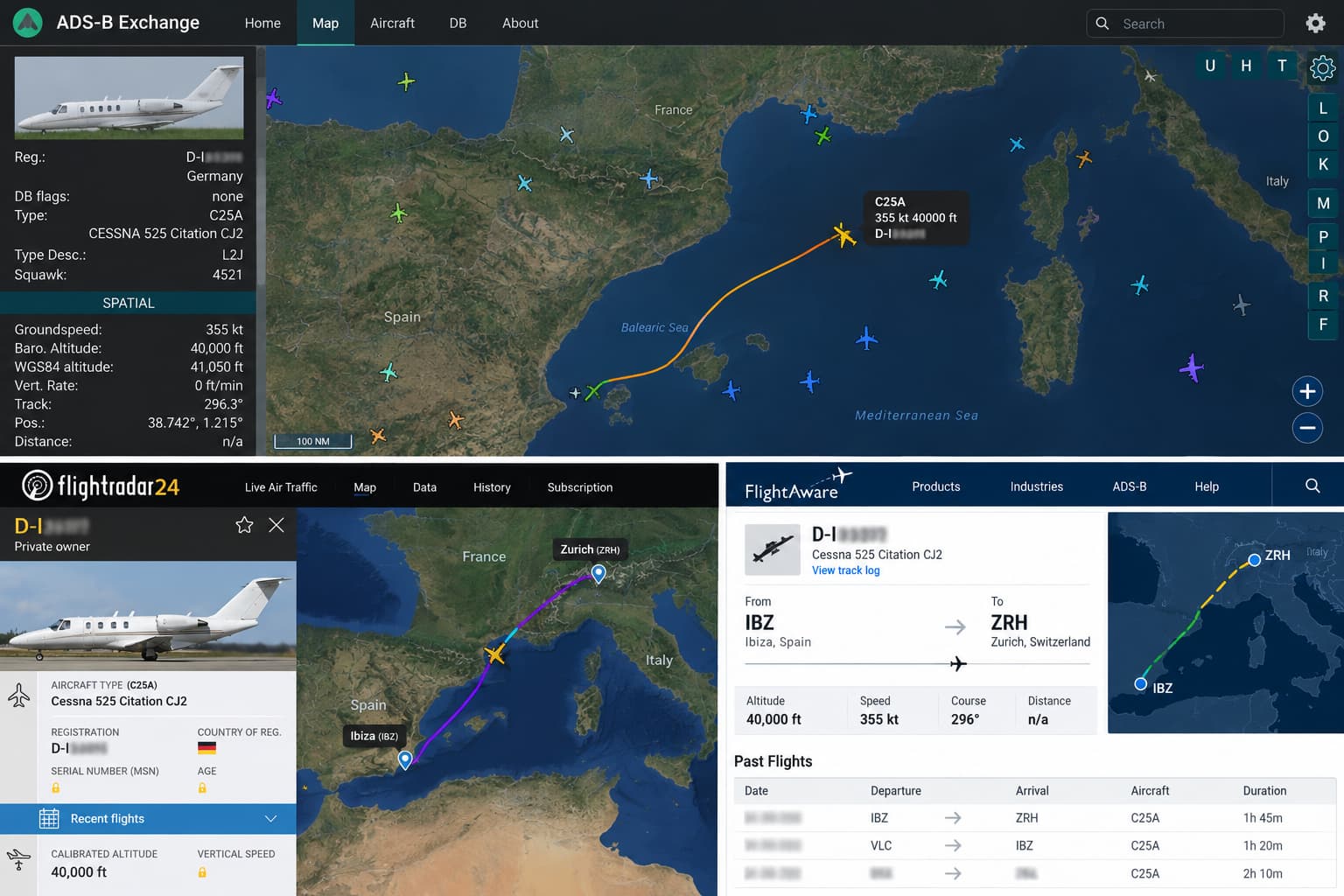
For confidentiality reasons, we have chosen to blur part of the flight code and not to include the exact dates of the flights in this test.
We identified the Cessna Citation and reviewed the data
We began our search by opening the ADS-B Exchange map. We looked at the aircraft displayed and selected one directly on the map. By clicking on the flight track, we opened the data sheet containing the available information, which allowed us to identify the registration number and Mode S code— which we are withholding for privacy reasons.
The information provided also included the model code C25A, which identifies the Cessna Citation CJ2, a business jet belonging to the Citation 525 family.
The data sheet also showed a ground speed of 355 knots and a barometric altitude of 40,000 feet. A WGS84 altitude of 41,050 feet was also listed.
These two values are not directly equivalent: barometric altitude and altitude relative to the WGS84 geodetic system use different reference systems. It is therefore important not to confuse them when consulting an aircraft’s technical data.
Data on routes was compared and reconstructed
After identifying the aircraft, we compared the information with data available on other platforms. Both Flightradar24 and FlightAware showed a flight between Ibiza and Zurich among the aircraft’s recent flights. The flight history also included other flights between European airports.
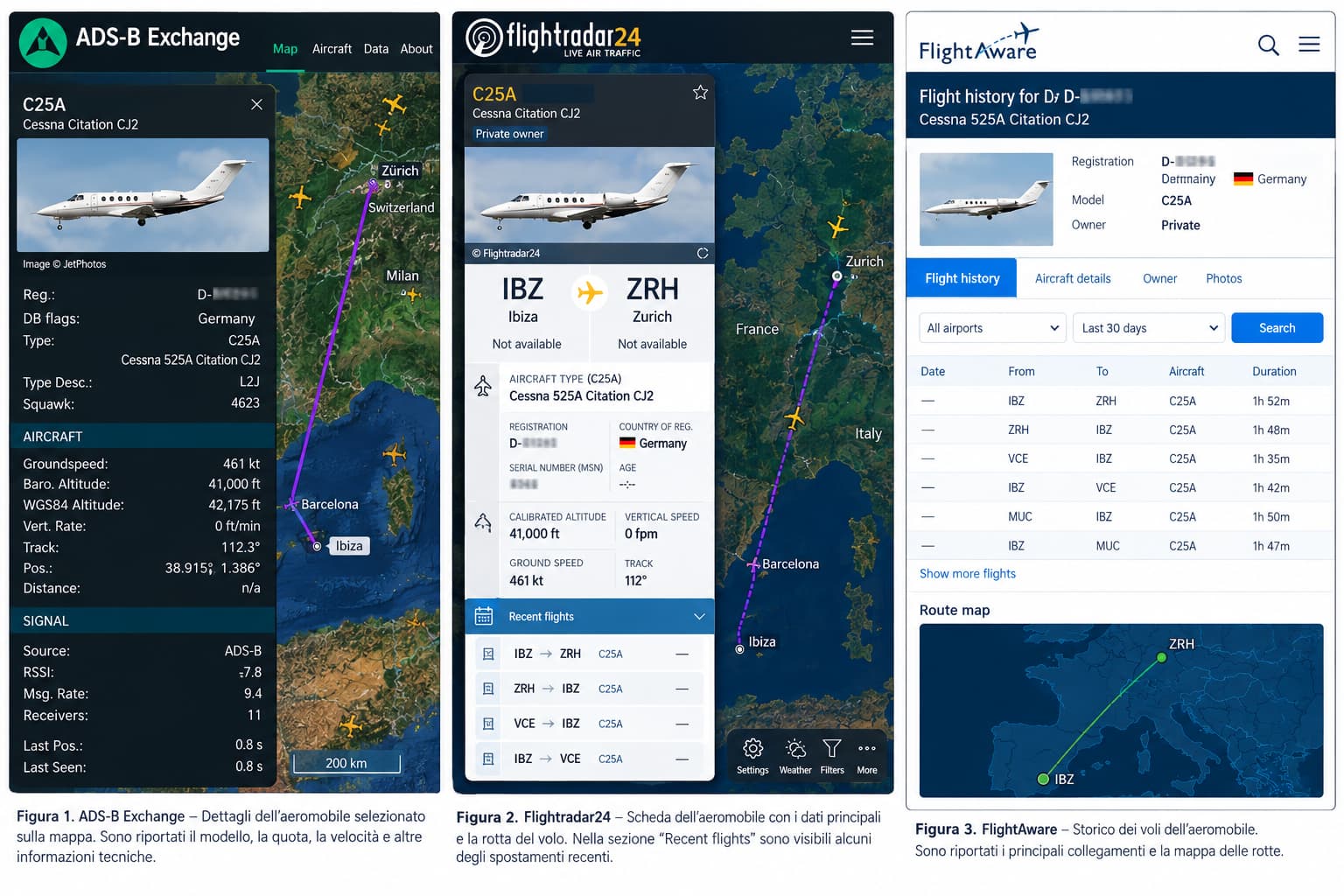
The comparison allowed us to verify certain information and to see how different platforms can provide complementary data.
All Cessna Citation Flights: What We Know
In addition to real-time location data, some platforms allow you to view an aircraft’s flight history. This feature lets you trace previous routes, identify departure and arrival airports, and check flight dates, when such information is available.
The flight history is not necessarily complete: the amount of data available depends on the service used, the retention period, and the coverage of the tracking networks. For this reason, comparing multiple sources can help provide a broader picture of a jet’s movements.
How do jet-tracking websites know the location of private jets?

It’s one of the most interesting questions: How do tracking platforms know where an airplane is, how fast it’s traveling, and at what altitude it’s flying?
The answer lies in the surveillance systems used in aviation. Aircraft transmit information via onboard equipment, while networks of ground-based and satellite receivers intercept these signals and make them available to the services that process the data.
Jet-tracking platforms therefore collect information from multiple sources, link it to specific aircraft, and turn it into the maps and profiles that we can view online.
The ADS-B system: Airplanes transmit their location
One of the most important technologies for tracking is ADS-B, which stands for Automatic Dependent Surveillance-Broadcast.
This is a system through which equipped aircraft periodically transmit information such as their geographic position, altitude, speed, and identification code. The position is normally determined by the satellite navigation systems installed on board, while the transponder transmits the data via radio signals.
This information can be received by antennas and receivers installed on the ground. Once collected, the signals are sent to the networks that power the tracking platforms.
Terrestrial receiver networks: Who picks up the signals?
A significant portion of the data used for jet tracking comes from ADS-B receivers located throughout the country. These can be installed at airports, specialized facilities, or in private homes by aviation enthusiasts who participate in data-sharing networks.
These devices intercept signals transmitted by aircraft within their reception range and forward them to the services that collect and process the information.
Coverage depends on the location of the antennas, the terrain, the distance of the aircraft, and the presence of obstacles. For this reason, an aircraft may be visible in a given area and temporarily disappear from the map when it moves out of the reception range of the available devices.
What is Multilateral Assistance (MLAT)?
Not all aircraft transmit their position information directly via ADS-B. In some cases, it is possible to use multilateration, also known by the acronym MLAT.
This technique makes it possible to estimate the position of an aircraft by comparing the times at which the same signal is received by multiple synchronized ground stations. By knowing the differences in reception times and the locations of the receivers, the system can calculate the aircraft’s position.
Multilateration therefore requires the presence of multiple receivers capable of receiving the same signal. It is not always available, and its accuracy depends on reception conditions and the distribution of the stations.
Satellite tracking to monitor aircraft over the oceans
Terrestrial receiver networks have geographical limitations: coverage may be extensive in densely served areas, but more limited over oceans and in remote regions.
To partially overcome this problem, some services also use ADS-B receivers installed on satellites. These devices can intercept signals transmitted by aircraft even when they are out of range of ground-based antennas.
Satellite reception therefore makes it possible to expand the geographic coverage of monitoring, although data availability depends on the service, the constellation used, and reception conditions.
Where does the other information displayed on jet-tracking websites come from?
Location and flight parameters aren’t the only data we can find on tracking platforms. Aircraft profiles may also include information on the model, registration numbers, operator, and departure and destination airports.
This data may come from aviation archives, registration records, technical databases, and flight-related information. It does not necessarily come from the same source as ADS-B signals and should not be confused with real-time observations.
It is precisely from the integration of these various sources that the information we can view when we select an aircraft on the map is derived.
Is jet tracking legal? Can we find out who’s on board?
The information displayed by jet-tracking platforms comes from publicly available aviation data. Consulting these services and publishing information about an aircraft’s movements does not automatically constitute a privacy violation. However, it is important to distinguish between reporting on or analyzing flight data and the systematic monitoring of a person’s movements, which can amount to surveillance and raise privacy and security concerns.

The case of Taylor Swift, which we discussed in our previous article, is a prime example. Tracking the singer’s flights showed just how easy it is to use data available online to reconstruct a person’s movements. But it also highlighted another point: it is incorrect to automatically attribute all flights taken by an aircraft to its owner.
In fact, a private jet can be used by the owner, by another authorized person, or for a charter service. The presence of an aircraft on a given route therefore does not indicate who is on board, who organized the trip, or who the passenger is.
There is also another limitation: as we saw in our practical test, it is not always possible to identify the owner of an aircraft with certainty. The tail number allows you to identify the aircraft and, in some cases, consult aviation registries to determine the individual or company to which it is registered. However, the registered owner may be a company, a leasing company, or another legal entity and does not necessarily correspond to the person actually using the jet.
Tracking data can therefore be useful for mapping a flight path, analyzing air traffic, or gaining insight into how private aviation operates. When such data is published, however, it is important to avoid arbitrary reconstructions of people’s movements and unsubstantiated attributions. The fact that information is available online does not give anyone the right to turn every aircraft movement into a news story about the private life of anyone who might be associated with that flight.
Frequently Asked Questions About Private Jet Tracking
Private jet tracking is attracting an increasingly broad audience: from the simply curious to aviation enthusiasts, all the way to business travelers who want to learn more about the world of private flights. But what tools should you use, and what information can you obtain? Here are some answers to the most frequently asked questions to help you better understand jet tracking platforms and make the most of their features.
What are the most reliable websites for tracking a private jet?
Among the best-known platforms are Flightradar24, ADS-B Exchange, FlightAware, AirNav Radar, and Plane Finder. There are also services that specialize in tracking private aircraft, such as JetSpy, and projects dedicated to collecting and providing access to aviation data, such as OpenSky Network. However, no single service necessarily displays all aircraft or all available data: coverage, flight history, and the information displayed may vary. To get a more complete picture, it can be helpful to compare multiple sources.
What is an airplane’s tail number?
The tail number is the alphanumeric code that identifies an aircraft; it is generally displayed on the fuselage. It is associated with the aircraft’s registration with the aviation authority of its country of origin and allows it to be distinguished from all other aircraft.
What are the letters and numbers on an airplane’s fuselage?
The letters and numbers on the fuselage may indicate the country of registration, officially identify the aircraft, or represent internal codes used by airlines. The tail number is the official designation that distinguishes one aircraft from another. The initials generally identify the country of registration: for example, I- for Italy, D- for Germany, F- for France, G- for the United Kingdom, and N for the United States. Other elements, such as fleet numbers and model designations, serve different purposes.
If I don’t have the flight number, how can I track a private jet?
You can explore the map on a tracking platform, locate the aircraft in the area of interest, and select them to view the available data. The model, location, altitude, and other identifying details can help you recognize the aircraft. However, it is not always possible to identify it with certainty without knowing the tail number or another associated code.
Can you tell us who owns the plane?
In some cases, it is possible to consult aviation registries and identify the individual or company in whose name the aircraft is registered. However, the registered owner is not necessarily the actual owner or the person who uses the jet.
May I ask where you’re headed?
If the flight is visible and the platform has the necessary information, it can display the expected destination or the destination that can be derived from the flight data. However, the destination is not always available or up to date: route changes, diversions, and unscheduled landings may occur.
How can I use tracking data without violating privacy?
It is important to distinguish between information related to the aircraft and that related to individuals. Flight data can be used for analysis and insights, but one must avoid attributing a specific trip to an individual without evidence or systematically reconstructing their private habits and movements.
Follow the world of private aviation with PrivateJetFinder.com
Follow the PrivateJetFinder.com blog and discover the world of private aviation through In-Depth Articles on Airplanes, airports, fun facts and useful information to understand how private jet charter works and plan trips to destinations all over the world.
If you’d like to plan a trip on a private jet and want to explore the options available for your route, contact PrivateJetFinder.com to receive a quick, personalized quote.
The post Jet Tracking: How to Track the Location of a Private Jet in Real Time first appeared on Private Jet Finder BLOG.