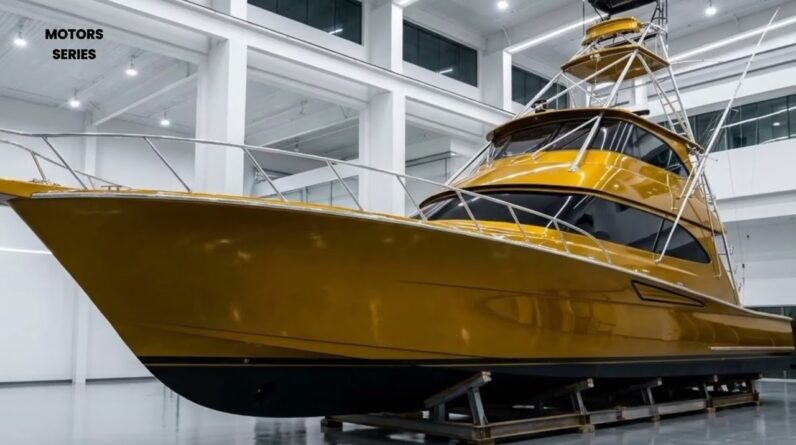



Marine technicians use heavy hole saw guide rigs to bore precise transverse tunnels through solid fiberglass hulls for bow thruster installations, turning complex marine carpentry and structural boring into a high-stakes operation where millimeter-level accuracy determines hydrodynamic alignment.
Executing a transverse bow thruster installation requires rigid alignment fixtures to prevent expensive core damage and misalignment across opposite hull sides. Technicians anchor a heavy-duty tubular guide frame and pilot arbor directly to the interior laminate before driving a large-diameter industrial hole saw through the thick, multi-layer fiberglass composite. As the bi-metal or carbide-grit saw cuts through woven roving and polyester resin, steady water cooling and controlled feed pressure prevent thermal scorching, ensuring a perfectly cylindrical tunnel ready to receive and laminate the fiberglass thruster tube housing.
Bow Thruster Hull Tunnel Boring Variables
Heavy-Duty Guide Rig Architecture: Rigid steel mounting brackets and center arbors lock the cutting axis perpendicular to the centerline, eliminating drill bit wandering across curved hull surfaces.
Large-Diameter Hole Saw Mechanics: Industrial-grade carbide-toothed or diamond-grit cylindrical saws shear cleanly through thick structural fiberglass and core materials without delaminating adjacent plies.
Transverse Tunnel Alignment: Precision cross-hull measurements ensure exact symmetry between port and starboard apertures, preventing uneven hydrodynamic thrust and drag.
#MarineEngineering #BowThruster #BoatBuilding #FiberglassHull #ShipyardTech #MechanicalEngineering #MarineTechnician #HullModification #CompositeStructures #AeroTech
Marine and mechanical engineering of bow thruster tunnel installation and heavy hole saw guide rig fabrication, troubleshooting core delamination, hole saw binding, and transverse centerline angular error, analyzing hull laminate thickness millimeters, rotational drill RPM limits, and feed force newtons, managing industrial core drills, guide rig mounting clamps, and coolant water lines, calculating total shear stress thresholds, fiberglass tensile strength limits, and water jet cooling flow rates delivered across hull boring operations, evaluating polyester/vinylester resin thermal tolerance, core material shear resistance, and drill arbor runout, researching marine construction standards (ABYC hull modification protocols, composite vessel repair guidelines) and mechanical engineering, mastering step-by-step procedures for aligning guide fixtures, securing drill arbors, and inspecting fresh fiberglass cut edges prior to tube fiberglassing, maintaining core drills, hole saw assemblies, and structural alignment jigs, detailing blueprint layouts for bow thruster placement, waterline clearance envelopes, and internal stringer intersection zones, diagnosing bit drift, smoke emission from resin overheating, or structural ply separation during cutting, and analyzing the physical impact of transverse tunnel cutouts on overall fiberglass hull structural rigidity.